


ProCat Solutions
Brain-to-brain multiplayer is live, and the lag is brutal
In 2014 two bits a minute crossed from one human brain to another. What can implanted chips do today, and what would a wordless conversation need?
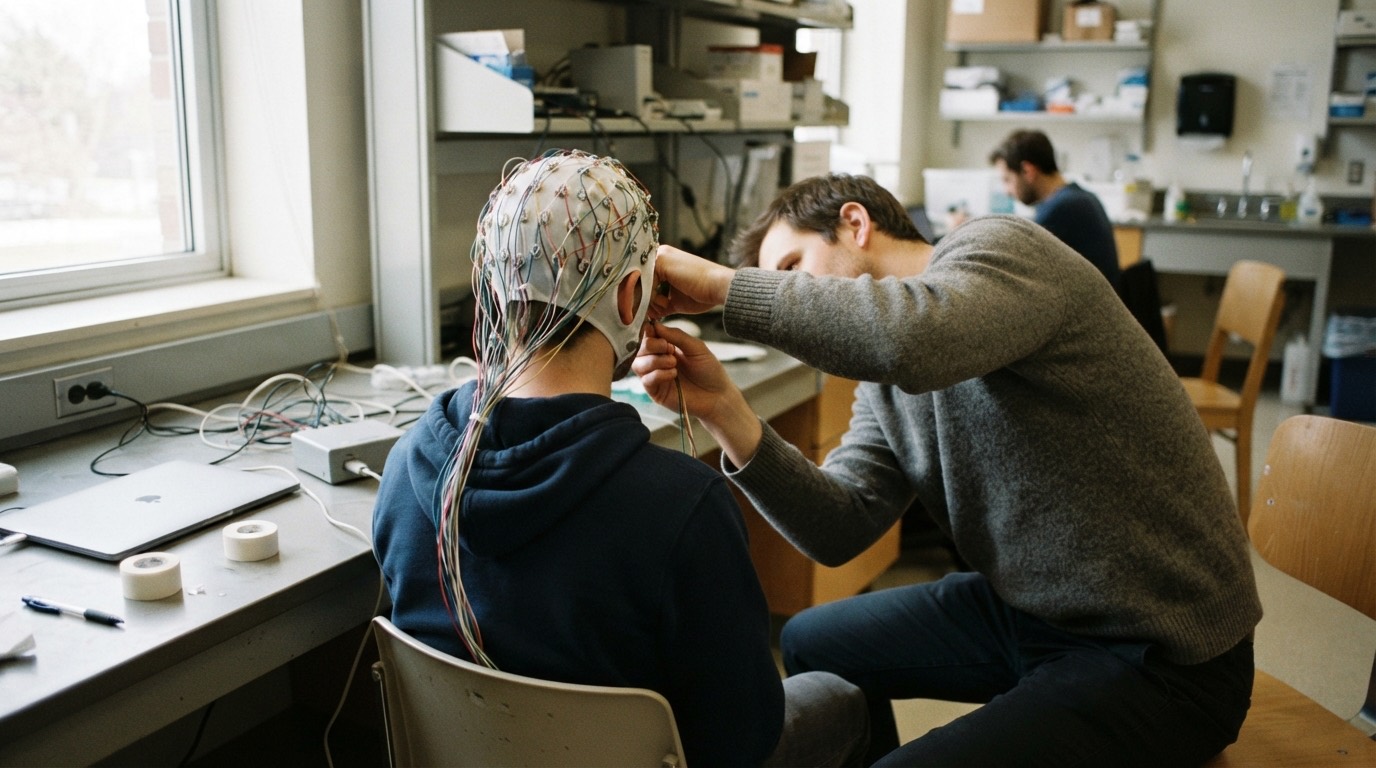
Two bits a minute. That is how much got across in 2014 from the brain of a volunteer in India to the brains of three people in France, when the greetings “hola” and “ciao” were sent from Thiruvananthapuram to Strasbourg. The sender wore an EEG cap and imagined moving either hands or feet: one meant a one, the other a zero. A magnetic coil held against each receiver’s head either produced a flash of light in the visual cortex or did not. In the two runs, 11 and 4 percent of the bits were lost on the way.
A five-letter word took minutes to arrive. So the obvious question is what would change if the cap and the coil were replaced by two implanted chips sending signals straight to each other.
What has actually been done
Three experiments come up whenever brain-to-brain links are discussed.
- 2013, Duke University: the brains of two rats were linked, one in Natal, Brazil, the other in Durham, North Carolina. The receiving animal’s cortex was stimulated according to the sender’s signals, and it had to work out which lever to press. The best result was around 70 percent.
- 2014, India and France: the “hola” and “ciao” above, with four healthy adults and no surgery.
- 2019, University of Washington: in a system called BrainNet, three people played a Tetris-like game together. Two could see the board and the third could not, so the third had to decide whether to rotate the block from the other two’s brain signals. Five groups of three averaged 81.25 percent accuracy.
In all three, a single yes or no went across at a time, and the signal always travelled through a computer and the internet.
What an implanted chip can do today
By early February 2026, 21 people had received Neuralink’s device. The chip uses 1,024 electrodes on 64 hair-thin threads. The human brain holds roughly 86 billion neurons, so the device listens to a vanishingly small share of them.
Reading is improving fast all the same. In August 2025 Stanford researchers reported in Cell that they could decode sentences that four paralysed participants only thought and never spoke. The system worked from a 125,000-word vocabulary, and accuracy reached 74 percent at best.
The opposite direction is far poorer. In the experiments published so far, the message written into a brain was a flash of light or a simple touch signal. Nobody has shown a method that delivers a sentence, an image or a feeling into another person’s brain.

The bandwidth runs out inside the brain
At the end of 2024 two Caltech researchers, Jieyu Zheng and Markus Meister, calculated that human thought and behaviour run at about 10 bits per second. Someone typing 120 words a minute manages the same. Meanwhile the senses collect around a billion bits per second.
If that estimate holds, a faster wire between two chips will not help: the slow point is the thought itself. The estimate is disputed. Neuroscientist Britton Sauerbrei told The New York Times that the authors had not fully captured the flow of information in the nervous system.
“Deeper” communication would therefore probably mean something other than faster speech. Today’s interfaces read out intended movement and inner speech. Two linked people might sense each other’s intention or attention without words. For that, two separately trained decoders would have to find a common language, because the signals differ from brain to brain.
Who owns a sentence you only thought
One by-product of the Stanford experiment was that the system also picked up inner speech the participant did not mean to share. The researchers added a password: decoding started only after the participant thought “chitty chitty bang bang”. The system recognised the password with more than 98 percent accuracy.
Linking two chips would therefore be a brain-to-software-to-brain connection, and the middle part decides everything. As software developers we see a familiar job there: who authenticates the two sides, where the signal is encrypted, who keeps the logs, and what happens when the connection drops. No published experiment answers these questions today, even though a sentence someone only thought is more sensitive than anything we have sent over a network so far.
Sources
- Grau et al.: Conscious Brain-to-Brain Communication in Humans Using Non-Invasive Technologies (PLOS ONE, 2014)
- Pais-Vieira et al.: A Brain-to-Brain Interface for Real-Time Sharing of Sensorimotor Information (Scientific Reports, 2013)
- Duke Health: Brain-to-brain interface allows transmission of tactile and motor information between rats
- Jiang et al.: BrainNet, A Multi-Person Brain-to-Brain Interface for Direct Collaboration Between Brains (Scientific Reports, 2019)
- eWeek: Neuralink’s Brain Chip Is Now Being Tested on Paralysis Patients in the UK (2 February 2026)
- Azevedo et al.: Equal numbers of neuronal and nonneuronal cells make the human brain an isometrically scaled-up primate brain (Journal of Comparative Neurology, 2009)
- Scimex: A brain-computer interface could decode the silent monologue in your head (on the August 2025 study in Cell)
- Zheng and Meister: The unbearable slowness of being: Why do we live at 10 bits/s? (Neuron, 2024)
- Carl Zimmer, The New York Times: The Speed of Human Thought Lags Far Behind Your Internet Connection