

ProCat Solutions
Left ×2, right −4: how 4X strategy became mobile's biggest money machine
Two 4X games, Last War and Whiteout Survival, earned $4.3bn between them in 2025. They open with one simple choice and switch on complexity step by step.
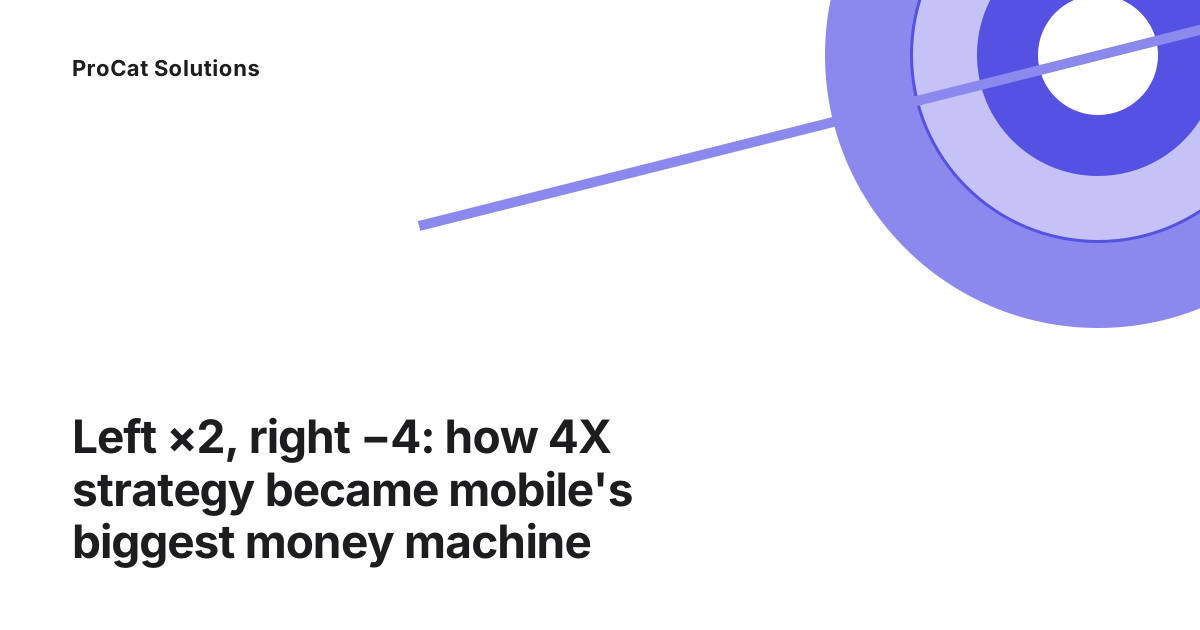
Soldiers run down a road towards two gates. The one on the left says ×2. The one on the right says −4. One swipe and the army doubles. That is the whole task. With this ad, Last War: Survival won over players who would never have downloaded a strategy game.
The two highest-grossing mobile games of 2025 were neither puzzlers nor shooters. According to Sensor Tower, Last War: Survival took close to $2.2bn, up 42.5% on the year before, and Whiteout Survival took $2.1bn, up 45%. Both are 4X strategy games: explore, expand, exploit, exterminate, as the genre was named in the 1990s.

The only growing genre in a flat market
The mobile games market as a whole barely moved in 2025. Sensor Tower puts total in-app spending at around $82bn, 1.3% more than the previous year. Strategy games grew 20% within that and passed $20bn for the first time. The report says it was the only category to grow in revenue, downloads and time spent playing.
The 4X subgenre showed its direction in the first half. A mobilegamer.biz roundup found it earned $3.9bn in the first six months of 2025, 28% more than a year earlier. There is room for newcomers: Florere Game’s revenue grew twentyfold in a year, Last Z: Survival Shooter made $470m and Dark War: Survival $380m.
One gate, then one more feature
The key is how these games begin. In the first minutes there is no map, no alliance, no resource management. There is one simple decision: left or right, ×2 or −4. The player wins, and the next gate arrives.
Then the game quietly switches something on. First a building that can be upgraded. Later a timer saying the upgrade will be ready in four hours. After that come hero cards, a research tree, a map with neighbouring bases and finally an alliance, where others expect the player to show up for the joint attack at 8pm. By the time players notice they are running a complex economic and military simulation, they have been playing for weeks.
The industry calls this progressive feature unlocking. Each new system arrives just as the previous one would start to bore, and each teaches a little about the next. The gate minigame from the ads, meanwhile, remains only a small slice of the full game. Naavik’s analysis says it was this ad, and the minigames built into the game, that brought Last War huge numbers of players who would never have downloaded a traditional strategy game.
The games at the top
- Last War: Survival (FunFly): the gate-runner minigame in the ads, with base building, heroes and alliance warfare behind it. Close to $2.2bn in 2025.
- Whiteout Survival (Century Games): keeping a city alive in a frozen world, with heating, resources and alliances. $2.1bn, up 45%.
- Last Z: Survival Shooter (Florere Game): zombie survival with shooter minigames, $470m.
- Dark War: Survival (Florere Game): the same recipe in a darker mood, $380m.
- Z Route: Redemption: a zombie apocalypse in which a car, not an army, crashes through the gates. The right gate means supplies; the wrong one means the horde.

Why people pay
4X games run on social obligation. Someone fighting in an alliance does not want to let their teammates down, and when an upgrade can finish now instead of in four hours, many pay for it. Revenue typically comes from a relatively small number of highly committed players who stay for months, sometimes years.
That takes constant operation. New events every week, seasons, new servers where newcomers can compete against each other. Most of the work begins at launch. The game is tuned every day from the data, with teams watching where players drop off, which event brought in revenue and on which server the balance has broken.

What runs behind the screen
Technically, a 4X game is a high-load, real-time, multi-tenant system. Parallel servers run the game worlds. Alliance chat and joint attacks have to work to the second. Timers and purchases must be handled so that an outage never causes a lost payment or a reward credited twice. Then there is the operations side: an admin panel for events, analytics, push notifications, payment integrations and fraud filtering.
These are the layers we work with every day. We build real-time backends, high-load APIs, admin and superadmin panels, subscription and in-app payments, cloud operations and monitoring, along with the mobile app. For a game studio, that means the team can focus on the game while the server side is handled by people who do the same work running SaaS products. The scale can be estimated in the SaaS calculator, using the real-time features, mobile app and app store payment modules.
Sources
- Sensor Tower: State of Gaming 2026 (wnhub summary)
- Mobile gaming hits $82B (Respawn / Sensor Tower)
- The top grossing mobile games of 2025 (PocketGamer.biz)
- Data digest: 4X and midcore stats (mobilegamer.biz)
- Sensor Tower: Top 30 Chinese publishers 2025 (Tiger Brokers)
- Why Last War is winning the 4X game (Naavik)
- Century Games & its 4X portfolio strategy (Naavik)
- Z Route: Redemption (Google Play)