

ProCat Solutions
Would you rent out your console when GTA 6 comes out?
Renting out a console by the hour while someone else plays on it over a stream. We looked at how it would work and why it gets stuck legally.

19 November 2026
Time left until GTA 6 launches
On PS5 and Xbox Series X|S. Rockstar has not announced a PC date yet. Source:Rockstar Newswire
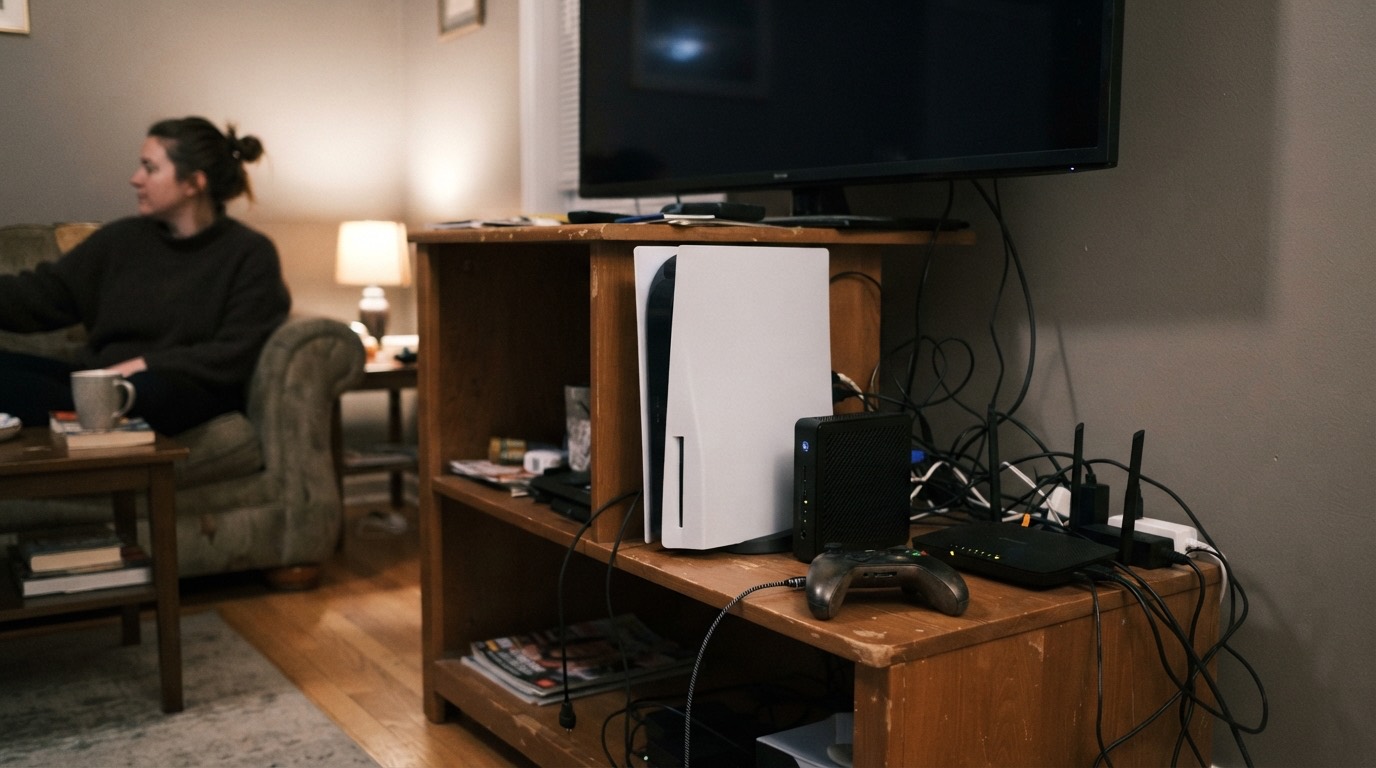
Rockstar has set GTA 6 for November 19, 2026 on PS5 and Xbox Series X|S, and the hype is on a scale rarely seen for a game. Plenty of people will buy a new console for it. Plenty will not, because it is expensive or because they want to try it before deciding. Between the two groups sits an obvious business idea: whoever has the machine at home rents it out for the hours they are not using it, and the renter plays on it over a stream from their own laptop, TV or phone. The owner earns money, the renter plays for less, the platform takes a commission. We worked through how it would run and where it hits a wall.
On launch day a lot of offices will see a strange spike in illness. According to a US survey, roughly 1.5 million workers may call in sick or take the day off on November 19, with estimates of about a billion dollars in lost productivity. The economists Fortune asked think that is probably overstated, and that the economy would cope even if it were not. In the UK the estimate is 2.5 million absences, so this is not only an American affair. If half the team wakes up with a fever on the morning of November 19, it may not be the flu. Those who do have to go in, or have no console of their own, could use a rented one in the evening.
A console by the minute
The owner registers the console, sets the time slots when it is available and states their upload bandwidth. The renter picks from nearby machines on a map or a list. Distance decides the experience: once latency climbs past a few tens of milliseconds, a fast action scene starts to feel sluggish. At booking the platform holds the fee in escrow, the renter connects, the session is metered by the minute, and at the end the owner is paid minus the commission.
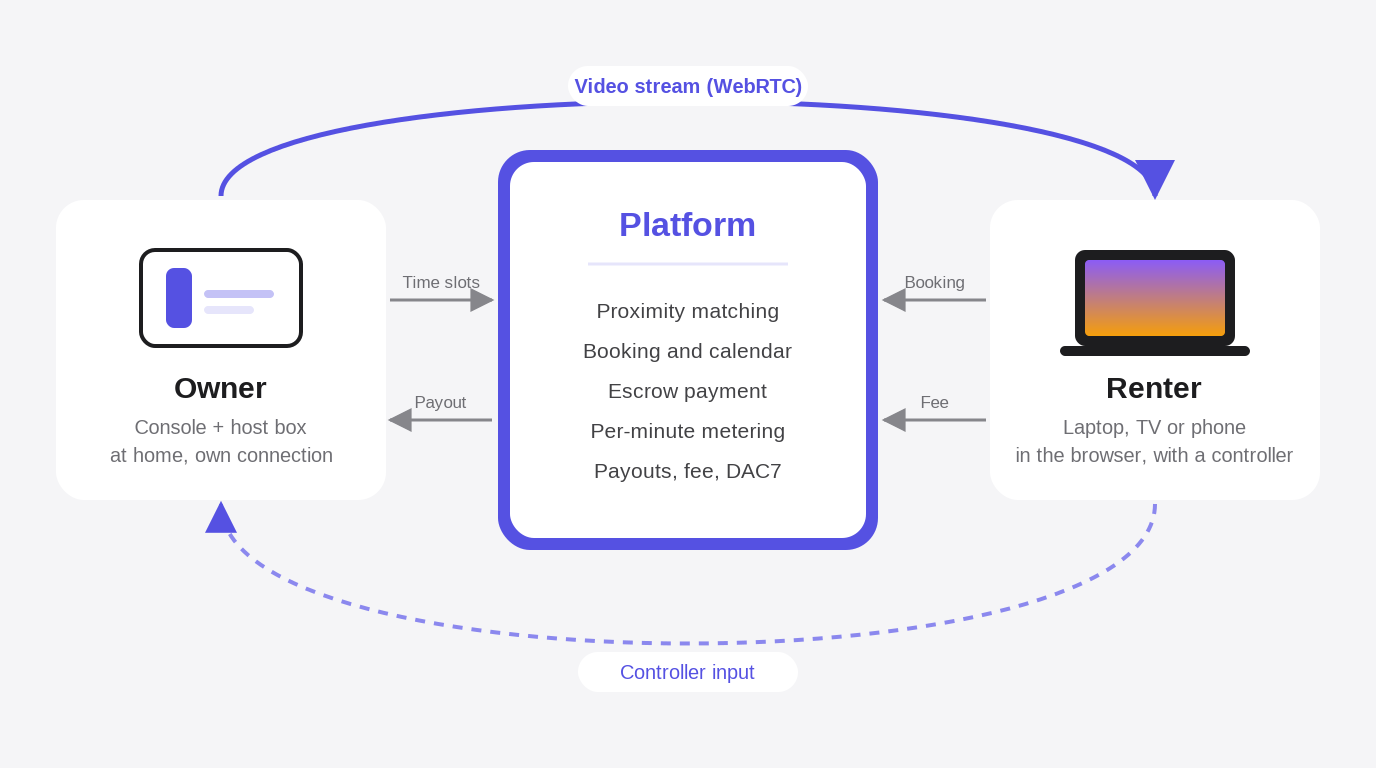
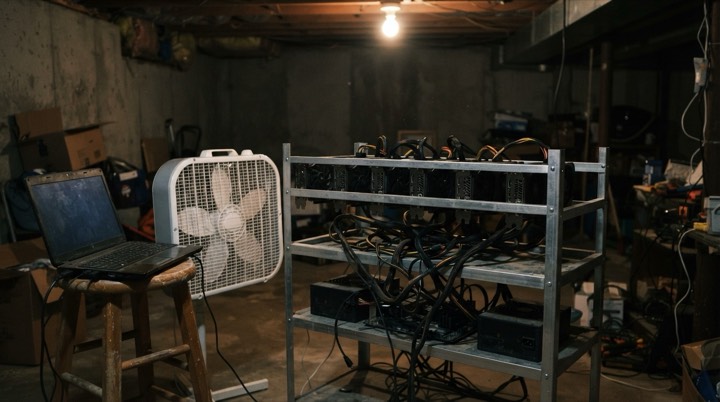
Technically there are two routes. One is the console makers’ own remote play feature, where the renter connects through the official app. The other is a small “host box” next to the console: a capture card, a mini PC, controller emulation and a WebRTC stream to the browser. The first is simpler, but someone else controls it. The second is entirely in our hands, at the price of shipping hardware to every owner.
The platform itself is a classic two-sided marketplace: profiles, a booking calendar, proximity matching, escrow payments, payouts to owners, ratings, dispute handling. We have built all of these before, in other settings.
The legal wall
The technology is solvable. The legal part is uncomfortable, and there is no point playing it down.
- Console platform terms. The terms of the big console online services typically cover personal, non-commercial use. Renting out a machine’s time for money conflicts with that. The consequence can be a suspended owner account, purchased games included.
- The game licence. Buying a game gets you a licence to use it; the game itself stays with the publisher. Publishers’ licence terms usually prohibit commercial exploitation and rental, and under the EU Software Directive renting out a program also requires the rightholder’s authorisation.
- Account sharing. If the renter plays on the owner’s account, it is a security nightmare: passwords, saves, purchases, bans for cheating. Logging in with their own account is cleaner, but the commercial-use question remains.
- Tax and platform obligations. Owners’ earnings are income, and under the EU DAC7 rules the platform has to report sellers’ revenue. This has to be handled from day one. It cannot be bolted on later.
This is not legal advice. Launching a product like this needs a specialist lawyer’s opinion first.
Three ways out
The technical side can be built. The real question is which business model holds up legally. We see three directions.
- Licensed partnership. An agreement with the publisher or platform is the only fully clean route. Hard for a blockbuster, realistic with independent publishers looking for new audiences.
- Own account, own licence, rented hardware time. The renter logs in with their own account and their own purchased game; the owner provides only the machine and the bandwidth. That takes game rental out of the picture. The commercial-use risk stays, and needs mapping with lawyers in advance.
- A physical venue. A console gaming room charged by the hour, where hardware and licences are our responsibility. Less scalable, but a long-standing, well-understood model.
If someone took the idea seriously, we would start with a mix of the second and first options: a narrow pilot, legally reviewed in advance, with a few independent titles and own-account login. GTA 6 would come onto the platform only with an agreement from the rightholder.
Bookings, prices, rewards
If the legal question is settled, this is what decides whether the platform survives. Everything below assumes the own-account, rented-hardware-time model.
Pre-booking launch night. Demand will peak in launch week, between six and midnight. That can be sold in advance: whoever books a slot weeks ahead gets a discount on the later price, say 15 to 20 percent. Owners see their earnings up front, and before launch the platform already knows which cities are short of consoles.
Pricing. Owners set their hourly rate; the platform suggests one based on local prices and demand. Evenings, weekends and launch week cost more, daytime less. Renters can buy hour packs (5, 10, 20 hours) at a discount, or a monthly pass if they play regularly but do not want to buy a console.
Payment and cancellation. The fee is held on the card at booking, and the owner receives it only for time actually played, minus the commission. Cancelling up to 24 hours before is free; after that a partial fee applies. If the connection drops on the owner’s side, the renter is refunded the lost minutes automatically. Owners are paid weekly through a marketplace payment system (Stripe Connect or similar), which also keeps identity checks and the data needed for DAC7 in one place.
Rewards. Every hour played earns points toward the next booking. In the referral programme both sides get credit: whoever brings in a new renter or owner, and the person they brought. Reliable owners (stable connection, good ratings, keeping to their availability) get a badge and rank higher in search. Gift vouchers work too: an evening of GTA as a birthday present.
For owners. A calendar, pricing, a bandwidth test, an earnings report, and one button to stop renting instantly if they want to play themselves. At sign-up they already see an estimate of what the console could earn with 10 to 20 rented hours a week.
The bill for building it
A platform like this is roughly a mid-sized SaaS project: a user web app and mobile app, an admin for owners, a superadmin for the operator, marketplace payments and payouts, real-time streaming and matching. Our SaaS platform calculator gives the order of magnitude with the marketplace, real-time features and mobile app modules switched on. The legal review is not included; it needs its own budget at the start of the project.